
Paying with a promissory note: using a note to buy something

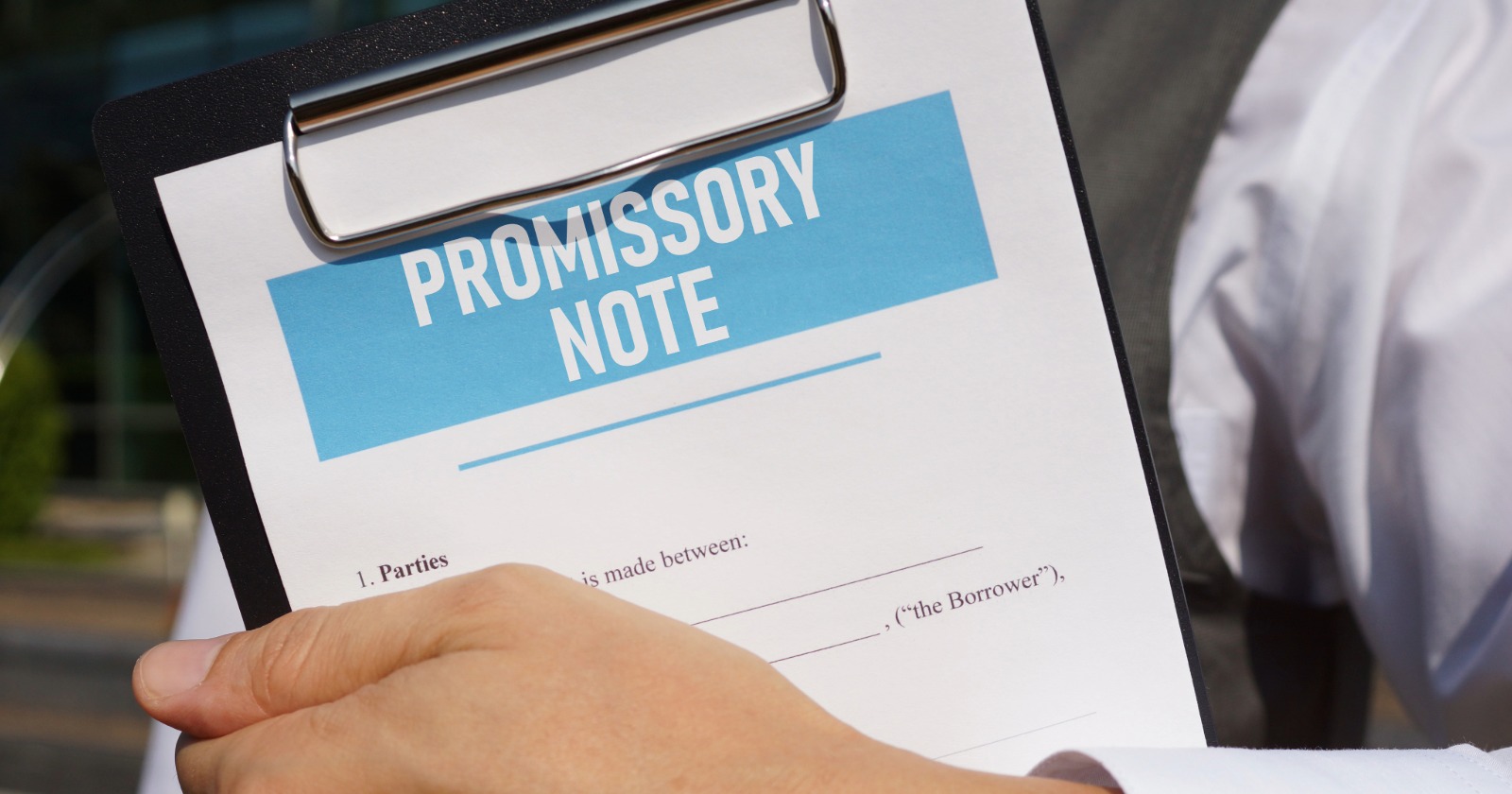
When a buyer hands over a promissory note instead of cash for a car, a piece of equipment, or a small business, the seller has just made a loan. This is often called seller financing, and it works well when a buyer can't get a bank loan or when the seller wants steady income. It also creates a debt, a lien question, and a tax filing. This guide covers personal property and small businesses. Real estate deals follow their own rules.
The seller becomes a lender
Once the note is signed, the seller is a creditor with all a creditor's risks. The note should state the price, any down payment, the amount financed, the interest rate, the payment schedule, and what happens on a late or missed payment. The amount financed is simply the price minus the down payment. In a labeled hypothetical, a truck priced at $30,000 with $6,000 down leaves $30,000 minus $6,000, or $24,000, on the note.
Pick a rate you can defend. It needs to stay under the state usury limit, which you can check with our usury limit checker, and it shouldn't be so low that the tax rules on unstated interest kick in, which we cover below.
It's also worth asking for a real down payment. A buyer with their own money in the deal is less likely to walk away, and the item you'd take back covers more of what's owed.
Securing the note with the item being sold
Without security, a seller who isn't paid is just another unsecured creditor. The fix is to keep a security interest in the item you're selling. Under the Uniform Commercial Code as adopted in New Jersey at N.J.S.A. 12A:9-203, a security interest generally becomes enforceable when value has been given, the buyer has rights in the collateral, and the buyer has signed a security agreement that "provides a description of the collateral".
Then make the lien visible to others. For a titled vehicle, the seller is usually listed as lienholder on the new title through the state's motor vehicle office. For equipment or business assets, the seller usually files a UCC financing statement with the state's filing office. If the buyer defaults, a secured seller can take the item back instead of standing in line with other creditors.
Negotiable versus nonnegotiable notes
New Jersey's version of UCC section 3-104 defines a negotiable instrument as "an unconditional promise or order to pay a fixed amount of money," payable to bearer or to order, payable on demand or at a definite time, with no other undertakings beyond a few allowed ones like protecting collateral. The same section says a promise isn't an instrument if it carries a conspicuous statement that it's not negotiable.
This matters most if the seller might sell the note later. A negotiable note can pass to a buyer who may qualify as a holder in due course, which can cut off many defenses the borrower has against the original seller. A nonnegotiable note can usually still be assigned, but the note buyer generally takes it subject to the borrower's defenses, such as a claim that the car was misrepresented. Note buyers tend to pay less for that extra risk.
Buyers often prefer a nonnegotiable note for the same reason: if the item turns out to be defective, they keep their defenses no matter who holds the note. Decide this up front and label the note clearly either way.
How the seller reports the payments
The Internal Revenue Service (IRS) explains the rules in Publication 537. It says "An installment sale is a sale of property where you receive at least one payment after the tax year of the sale." If the sale produces a gain, the seller can usually report the gain as the payments arrive instead of all at once, using Form 6252.
Publication 537 splits each payment into three parts: interest income, a return of the seller's adjusted basis, and gain on the sale. The interest is reported as interest income, the basis portion isn't taxed, and the gain portion is found by applying the gross profit percentage, which is the gross profit divided by the contract price.
A few limits apply. You can't use the installment method to report a loss. Regular sales of inventory don't qualify, and neither do dealer sales. If you sell property you depreciated, such as business equipment, any depreciation recapture income is reported in the year of sale, even if no payment arrives that year. When you sell a whole business, the price has to be allocated among its assets, since some of them, like inventory, can't use the installment method.
When the stated interest is too low
If the note doesn't provide for adequate stated interest, the IRS may recharacterize part of the principal as interest. Publication 537 measures this against a test rate tied to the applicable federal rate. For personal-use property, the buyer can't deduct that unstated interest, but the seller still has to report it as income.
The buyer's side of the deal
For the buyer, the note is a debt like any other. Missed payments can lead to repossession, and a buyer usually can't sell the item free and clear until the lien is released. When the last payment clears, the buyer should get the original note back marked paid, plus a lien release or a clean title.
On taxes, a buyer who uses the item in a business may be able to deduct the interest paid, subject to the rules for business interest. For a personal car or other personal-use property, interest on the note generally isn't deductible.
Selling or canceling the note later
A seller who later sells the note to an investor, or forgives part of it, has a tax event. According to Publication 537, if you sell the obligation or accept less than face value, "your gain or loss is the difference between your basis in the obligation and the amount you realize." Canceling the buyer's debt or giving the note away is measured against the note's fair market value instead.
Before anyone signs
Before signing, confirm the note states the price, down payment, rate, and schedule, that a separate security agreement describes the item, that the lien is noted on the title or filed, and that the note is labeled negotiable or nonnegotiable.
Sources
Sarah McCullen is a writer covering personal finance, lending agreements, and everyday legal documents. Sarah transforms complex promissory note terms into clear, practical guidance so individuals can create and understand agreements without unnecessary confusion.
View all posts →Create Your Promissory Note
Need a promissory note? Create one now for $7.99 - state-specific and professionally formatted.
Get Started - $7.99